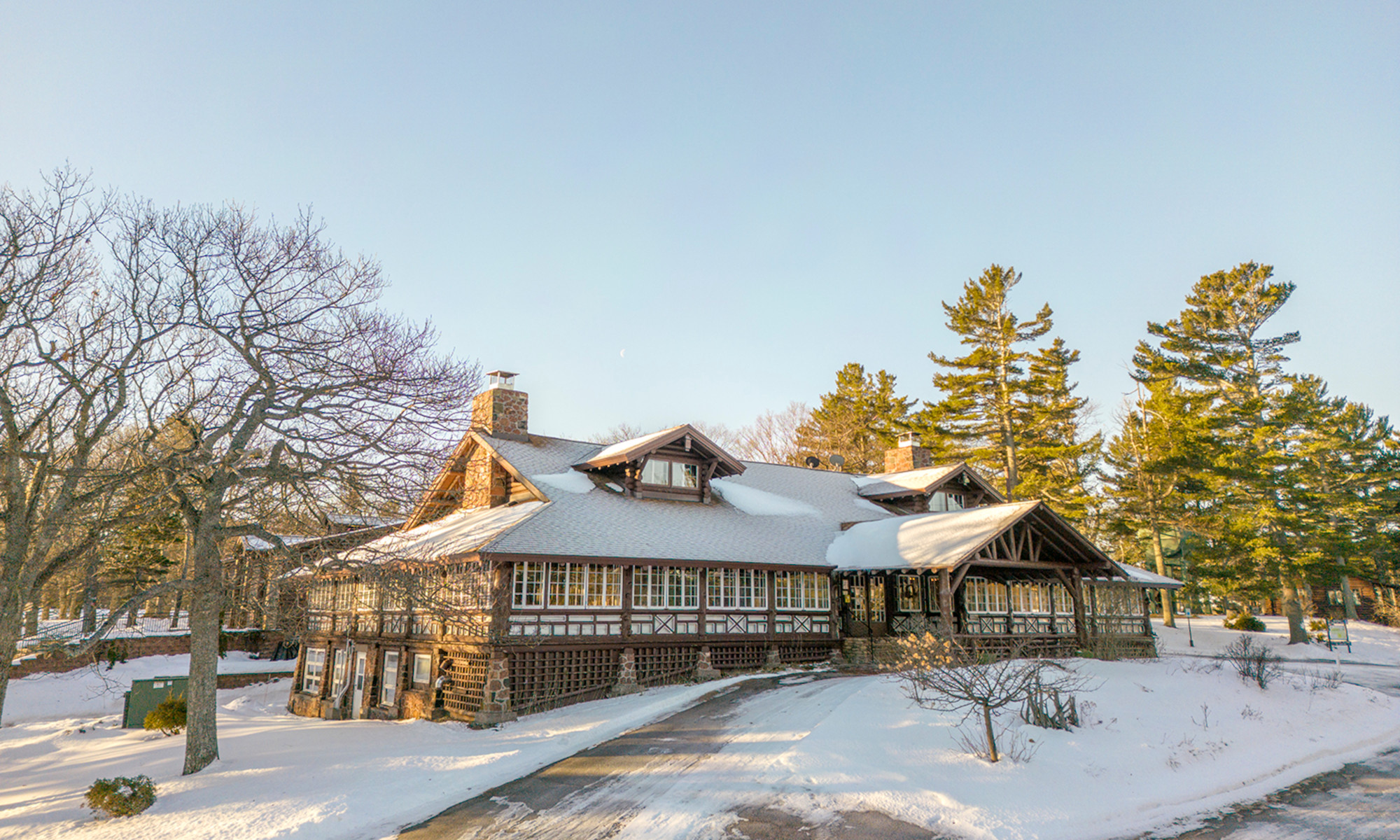
In September 2018, Keweenaw Resort, LLC bought the Keweenaw Mountain Lodge from Keweenaw County. This page covers what we have done since then, and why. For what came before, how the Lodge declined from the mid-1990s until the sale, see Why the Lodge Went Downhill (1995–2018).
Watch First, Then Let the Data Decide
None of the changes described on this page were made the day we bought the Lodge. When we bought it in 2018, we did not arrive with a plan to change everything. For the first year, from the purchase through October 2019, we kept the team, the prices, the memberships, and the leagues largely as they were, and we watched. We wanted to see how the Lodge really ran, and who it really ran for. We did start on the repairs that could not wait. Before opening in May 2019, we replaced the Lodge’s worn carpet, furniture, and fixtures, set up a library, and began putting new roofs on the cabins, paid for with a capital improvements loan we took on ourselves.
That first year showed us the same pattern described in Why the Lodge Went Downhill (1995–2018). The golf course lost money, and memberships brought in about 2% of golf revenue. Members with carts stored in the cart barn brought friends onto the course without paying a green fee. Weekly leagues filled the tee sheet ahead of the guests staying in our cabins. Twice in one season, a member confronted our staff, once over being served ahead of cabin guests at the bar and once over a league tee time. And the cabin roofs were failing under as many as five layers of shingles. The customers who had run the Lodge for decades were still trying to run it.
From then on, each year began with a review of what the last year’s numbers showed, and the decisions followed the numbers:
- 2020. We ended golf memberships and tournaments, opened the course to everyone, and made 2020 the last season of cart storage. Rounds rose about 17%. We finished the new roofs, went year-round, and stayed open through the pandemic without closing and without laying anyone off, while many hospitality businesses had to lay off their staff. We also began moving the team from hourly pay to salaries. Not everyone was ready to switch at once, so the move took a few more years, as each person became comfortable with it.
- 2021 and 2022. We began rebuilding the cabin bathrooms one at a time, joined Audubon International’s program for golf courses, bought the 383 acres next to the Lodge and donated conservation and trail easements on them, became an International Dark Sky Park, and turned dining into private dinners with our chef.
- 2023 and 2024. We held the first Upper Peninsula Dark Sky Festival, turned the former banquet room into the Education Center, with a Class Room for workshops and a Learning Room on the Lodge’s history, ecology, and food, became a Certified B Corp, earned Audubon International Gold Green Lodging certification, and made the whole resort for cabin guests only, with the Keweenaw Dark Sky Park still open to everyone at night.
- 2025 and 2026. We added solar power, bought 40 acres of forest surrounded by The Nature Conservancy’s land, brought the golf course in line with the rest of the resort, for cabin guests only, made the course walking-only and hickory-only, earned Audubon Cooperative Sanctuary certification for the golf course, built out the Education Center’s Learning Room with activity tables and a books-and-games lending program for guests, and began setting up the KML Foundation, a nonprofit for education tied to the Lodge.
None of these changes was a reaction to a complaint, and none was made to satisfy the loudest customers. Each one came from the data, and each one was measured against a single question: does this get our guests closer to nature? The order mattered. We watched. We observed. We let the data from those observations tell us which decisions needed to be made. Then we made them one at a time, over eight years, not all at once.
From a Golf Course to Five Businesses, and Back to One Purpose
The Lodge was not built as a lodge. It began as a golf course, and each part was added on top of the last (historical timeline; Paul LaVanway, The Keweenaw Mountain Lodge Story, 2010).
| When | What happened | What the Lodge became |
|---|---|---|
| 1933–1934 | Road commissioner Ocha Potter conceived a public golf course and clubhouse to put people back to work. Work began on November 6, 1933, with a crew of 124, on land from the Keweenaw Copper Company, and that month the Road Commission board named itself the Board of Park Trustees. Nine holes were built. A second nine was turned down for funding four times and never built. | A golf course |
| 1935 | The clubhouse, today’s Lodge building, opened on June 23, 1935, before more than 2,000 people. It was built with a dining room in one half and a lounge and bar in the other. Opening week brought a golf tournament and a Ladies’ Day golf and bridge event. | A golf course with a clubhouse and a bar |
| 1936–1948 | Twenty cottages, today’s cabins, were built with WPA funds from 1936 to 1940, and four more in 1947–48, paid for from the Lodge’s own profits. Golf was free to cottage guests; everyone else paid a small fee. Gatherings grew too, such as a Michigan College of Mining and Technology alumni reunion in August 1936. | A golf resort for cottage guests |
| 1940–1959 | By 1940, revenue averaged about $70,000 a year, and profits went into the county’s general fund. The high point came from 1945 to 1955. In 1955, to fill the course, the Lodge began selling golf tickets of eight rounds for $10, the start of annual golf memberships. | A profitable resort, with a local golf club taking root |
| 1960–1971 | Business fell off. The roofs needed replacing, but no capital fund had ever been set up. In 1960, the county traded for full title to the state land under some of the cabins, because it was preparing to sell the Lodge to a private operator. In 1964, the county sold the Lodge on a land contract. The new operators renamed it the Keweenaw Mountain Lodge in 1965, and later operators added a pool, remodeled the lounge, and dropped the “jacket and tie after 5” rule. Two operators defaulted, and by 1971 the county had it back for good. | A resort run by whoever would take it |
| 1977–1998 | Dining became a main source of revenue, with Saturday smorgasbords and Sunday buffets that drew up to 400 people. A motel built in 1984 brought the Lodge to 41 rental units. Behind the busy dining room, the buildings kept aging. | A restaurant and gathering place, with lodging on the side |
| 2006–2011 | A $3.3 million expansion added a conference center, winterized part of the Lodge, and upgraded its utilities, paid for with a $1.273 million USDA loan and a $1.754 million federal grant. The grant required a good-faith effort to stay open year-round, so the Lodge opened for its first winter in December 2009. Weddings and banquets became a large share of revenue. | A conference and wedding venue, carrying new debt |
| Through 2018 | Lodging, a restaurant, a bar, golf memberships, and weddings and other events each served its own customers. | Five businesses run like a local social club, with no single focus |
| 2019–2024 | First full season under private ownership in 2019. In 2020, the motel became employee housing, the Lodge announced year-round operation, and the bar closed. In 2022, dining moved to private dinners in the Tasting Post. The last outside wedding was in October 2023. In December 2024, the whole resort became for cabin guests only. | A historic lodging establishment that gets people closer to nature |
Each expansion under the county added another business and another group of customers, but none of them came with a single purpose. The Lodge grew bigger without growing more focused. Since 2019, the change has gone the other way: fewer businesses, one guest, and one direction. Simple and focused.
A Lodge, Not a Bar
The bar has been part of the Lodge since the day it opened. The clubhouse was designed with a dining room in one half and a lounge and bar in the other, and by 1939 a basement grill served drinks too (LaVanway, pages 9 and 18). In its last decades under the county, much of the Lodge’s life centered on the bar. In 2015, food and drink brought in about 40% of the Lodge’s revenue, close to lodging’s 49% (2016 Best Use Study). Beer cost less than at other bars, and the bar regulars were one of the five customer groups pulling the Lodge in their own direction.
We no longer build the Lodge around alcohol. People do not come to the Keweenaw Mountain Lodge to have a drink. They come to stay in a cabin, spend time outdoors, eat well, and learn something. The bar closed in 2020 and has not reopened. Today, alcohol is sold only through the Little Cabin Cafe, with a focus on craft drinks, and a drink goes with a meal; it is not the reason to come. Alcohol is not allowed on the golf course at any time, because golf is an athletic sport, not a drinking sport (golf course terms). The old bar, the curved wood bar in the Great Room, is now the Affogato Bar.
One Business, One Guest, One Direction
Under the county, the Lodge tried to be five businesses for five different groups of customers: lodging, a restaurant, a bar, a golf course, and an event hall. With no single purpose to hold it together, each group pulled the Lodge its own way, and the loudest group usually won.
Today, the Keweenaw Mountain Lodge is a historic lodging establishment. Not a golf course. Not a restaurant. Not a bar or an event hall. Lodging is front and center, and it is how we run our operations. The golf course, the trails, and our other outdoor activities, our rustic worldly food, and our education programs all exist to support the stay in our historic cabins. They are not separate businesses competing for separate customers. Many people still think of the Lodge as a golf course or a restaurant that happens to have cabins. It is the other way around: a place to stay, with golf, food, and learning that make the stay worth taking. Our customers are cabin guests, and every reservation is for at least two nights. A remote wilderness lodge with a 3 p.m. check-in and an 11 a.m. check-out leaves too little time to unwind and enjoy the area in a single night (why we have a two-night minimum). Our guest is not someone who drops by for a drink or a round of golf and leaves. Our guest stays, and everything else is built around that stay.
We know why we exist: to give cabin guests in our target market a fun, joyous, and adventuresome wilderness experience that brings them closer to nature. We know how we do it: through our historic lodging, supported by those three things. And we know what we offer: rustic facilities on a historic property, access to the wilderness, rustic worldly food, and learning. Our target market sits where three groups meet: outdoor activity enthusiasts, culinary enthusiasts, and people who value the Lodge’s history and want to see it move forward. That last part matters. Valuing the Lodge’s history is not the same as wanting to go back to it, and the guests we serve want both the history and the future.
Our target market is narrow on purpose. We focus on guests where three interests meet: people who value the Lodge’s history and want to see it move forward, outdoor activity enthusiasts, and culinary enthusiasts (About the Lodge). That is a niche, and focusing on it is a strength, not a weakness. Under the county, the Lodge tried to be everything to everyone: a restaurant for diners, a bar for regulars, a club for golfers, a hall for weddings, and lodging for travelers. Trying to please everybody pleased nobody. A clear niche tells us what to build, who to market to, and what to say no to, and it brings guests who come for what the Lodge actually is. Remote, seasonal hospitality is hard. Businesses that try to be a restaurant, bar, event hall, and lodging at once struggle to make the numbers work, under any owner.
Insurance points the same way. Since 2018, we have paid about $290,000 in insurance premiums, and our insurer is strict about our focus on cabin guests. A guest who has a reservation and is staying with us is a known, manageable responsibility. A stream of people who are not staying here, on the golf course, the grounds, and in the buildings, is a liability that makes insurance companies nervous. Keeping the resort for cabin guests is part of what keeps the Lodge insured.
Every decision runs through the same filters: that purpose, our core values, our brand, and our sustainability commitments, held to outside standards by B Lab and Audubon International. Our approach to the Lodge’s past is to marry history with the future, and that leads to a vibrant and progressive present. The county era never had that kind of clarity. That is why its decisions changed with whoever complained last, and why ours stay consistent year after year.
Focus also changed what it takes to run the Lodge. In 2019, trying to serve everyone took 57 people over the course of the year, most of them seasonal and hourly, and the team turned over constantly. In 2026, nine people run the Lodge, our family included (Lodge timekeeping records). Everyone is paid a salary, year-round, and is paid more than before: for everyone on the payroll, pay per hour worked has risen from about $14 in 2019 to about $24 in 2026, and for team members outside our family, from about $15 to about $26. Both are roughly 70% higher (Lodge payroll records). Everyone also receives our full set of employee benefits, from health and life insurance, retirement savings, and employee housing to continuing education, a technology stipend, and paid weekly time outdoors. No one is laid off at the end of a season to draw unemployment, the way seasonal county jobs at the Lodge worked. No one has joined or left the team in the past two years. Every job at the Lodge exists because our guests need it, not to fill a roster. A small, steady team can know every guest by name, keep standards consistent, and plan years ahead instead of rehiring every spring. That is what focus buys a business.
Focus helps our guests too. Because we say plainly who the Lodge is for, people can decide for themselves before they book. Those who want a wilderness stay, history with a future, good food, and time outdoors choose us. Those who want something else choose somewhere else, and we respect that choice. Both outcomes are good ones.
The 383 Acres: Bought for Nature, Not Development
We did not set out to buy more land. In 2020, we asked the county for a simple easement to revive an old snow terrain park. The county decided instead to sell the 383 acres next to the Lodge, to shed its liability for the land and its trails (acquisition history).
We bought it for two reasons: to keep about 11 miles of trails open, and to keep a natural area around the Lodge. As part of the purchase, we donated two easements: a conservation easement that protects most of the land from development forever and keeps it open for public recreation, and a trail easement that keeps its trails open to the public (DNR memo). Only 70 acres sit in a development envelope. The rest stays forest, and its low property tax of about $4,000 to $5,000 a year reflects that.
Later in 2022, The Nature Conservancy bought more than 32,000 acres of forest around us from a global investment firm, the Keweenaw Heartlands, and kept it open to the public (The Nature Conservancy). In November 2026, nearly 10,000 of those acres became public state land, with The Nature Conservancy holding the rest until it, too, can move to public ownership. Together, those purchases mean the Keweenaw Mountain Lodge now sits inside a wilderness, instead of next to land that could have been broken up and sold. That is what getting people closer to nature looks like.
In December 2025, we bought one more piece of land for the same reason. A 40-acre parcel sat in the middle of The Nature Conservancy’s land, connected to ours through the 383 acres. It had been split off in 2020 for a proposed 263-foot cell tower, which was never approved, and it later passed to AT&T. We bought it to keep it part of the wilderness around the Lodge, not a site for development (acquisition history).
Stronger Since 2018, Not Weaker
The people who want the Lodge back the way it was describe a place in decline under its “new owners.” The record shows the opposite. In eight years, the Keweenaw Mountain Lodge has gone from a seasonal, debt-ridden county operation to a year-round business with independent certifications most resorts never earn.
| When | What changed | Source |
|---|---|---|
| Sep 2018 | The Lodge is sold; the county is released from more than $4 million in federal obligations, and the property returns to the tax rolls (more than $280,000 in property taxes paid through 2026) | Mining Gazette |
| 2019–2020 | Every cabin gets a new roof, the first full tear-off since the cabins were built: golf-course side in spring 2019, forest side in spring 2020. The Outdoor Activity Center and employee housing follow in 2024 | Lodge records |
| 2020 | The Lodge becomes year-round, and never closes during the pandemic, serving take-out when indoor dining was limited, and lays no one off | KML |
| 2020 | Golf opens to everyone instead of members; rounds rise about 17% over 2019 | KML |
| Winter 2020–21 | First winter the Lodge stays open continuously in a decade | KML |
| 2021 | Golf course joins Audubon International’s Cooperative Sanctuary Program, starting the work toward certification | KML |
| Winter 2021–22 onward | Cabin bathrooms rebuilt one at a time: six forest-side bathrooms in cabins 18, 24, and 25 in winter 2021–22, then cabins 12, 14, 16, and 23, with cabin 10 under way in 2026. New floors, ceilings, toilets, copper sinks, and lighting, with vanities, trim, and shelves built by the Lodge’s own maintenance team. Cabins refurnished the same way | Lodge records |
| Mar 2022 | 383 acres added and protected by conservation and trail easements | KML |
| Jun 2022 | Dining becomes private, one-on-one dinners with the chef in the Lodge’s Tasting Post | KML |
| Jun 2022 | Designated an International Dark Sky Park, with the Lodge as headquarters of the Keweenaw Dark Sky Park | KML |
| Jul 2022 onward | EV charging added: a Level 2 Rivian Waypoint charger at the Lodge building (plus a second Lodge-owned charger in Calumet), then chargers at cabin 12 (2023), cabin 22 (2025), and cabins 10 and 11 (2026). Some guests now book their cabin because of it | KML timeline |
| Apr 2023 | First Upper Peninsula Dark Sky Festival; the fifth is set for April 2027 | KML |
| Mar 2024 | Certified B Corp, with a score of 80.3 against a median of 50.9 for ordinary businesses | B Lab |
| May 2024 | Certified Gold, Audubon International Green Lodging | KML |
| Dec 2024 | Cabin guests only: quieter grounds, fewer cars, less disturbance to wildlife. The Dark Sky Park stays open to everyone from 7 p.m. to 7 a.m. | KML timeline |
| Aug 2025 | Solar power with battery on the water treatment building | KML timeline |
| Dec 2025 | 40 acres bought from AT&T, a former cell tower site surrounded by The Nature Conservancy’s land and connected to the 383 acres, kept as wilderness | KML |
| 2026 | Golf course becomes walking-only and hickory-only | KML |
| Aug 2026 | Golf course certified as an Audubon Cooperative Sanctuary, the Lodge’s second Audubon International certification | KML |
| 2026 | KML Foundation being set up as a 501(c)(3) nonprofit for education tied to the Lodge (scholarships such as Upper Peninsula Dark Sky Festival tuition, the Lodge’s history, Audubon and B Corp work, historical projects), funded by parking fees, event fees, and donations, not by taxpayers | KML Foundation page |
The certifications are only part of it. Since 2018, we have also made the property more efficient and more open. Smart thermostats (Nest and Mysa) now control the heat in the cabins, the Lodge building, and the employee housing building, and the lights are LED. We follow a lighting management plan as part of the Keweenaw Dark Sky Park. An air quality sensor and an all-sky camera share live readings and images on our website, and EV chargers serve guests who drive electric. Beyond the roofs, we have invested more than $500,000 in equipment, furniture, and EV chargers. We also post regularly on our blog. The posts are not there to promote the Lodge. They are there to inform: what we are doing, and why.
The golf course tells the same story. In 2019, a non-cabin guest paid $18 to $22 for nine holes. For six years after the sale, from 2019 through 2024, Keweenaw County residents received a 10% discount on green fees, hardly the record of owners who shut out locals. Today, the whole resort, golf course included, is for cabin guests only, and each cabin guest can play one nine-hole round free each day. The one exception is the Keweenaw Dark Sky Park, open to cabin guests and visitors alike for stargazing from 7 p.m. to 7 a.m.
Read the background: Why the Lodge Went Downhill (1995–2018) explains how the Lodge declined under county ownership, and why these changes were needed.