
Who Really Ran the Lodge?
The Keweenaw Mountain Lodge did not fail because of one bad manager or one bad season. It declined for more than twenty years, from the mid-1990s until it was sold in 2018, because the people who used it were the people who controlled it.
On paper, Keweenaw County owned and managed the Lodge. In practice, county ownership was the means, not the cause. A property owned by a governmental agency belongs to the public, and the public that cared most about the Lodge was its customers. They did not buy it, finance it, or carry its losses, yet they decided how it was run.
The county did not run the Lodge the way it did by choice. Its customers pushed it there. A small group of local regulars learned that a complaint to a commissioner could overturn any decision, and the system rewarded them every time they used it. That system, not any one commissioner or manager, produced decades of poor business decisions.
This page grew out of our own research into why the Lodge declined. When we bought it in 2018, we assumed what most people assume: that the county and its managers were to blame. Watching how the Lodge ran from the inside, and listening to people who worked here under the county, changed our minds. The county and its managers were in a no-win position. The cause was a system that let a small group of customers make the decisions, and the customers who used that system to their own advantage. Every change since has tested that finding. Each time we moved the Lodge toward its cabin guests, the past customers, no longer the guests we serve, pushed back the same way they once pushed the county board, and each time their reaction confirmed it.
What follows explains why the Lodge went downhill, what we did once we understood the cause, and how that made the Lodge what it is today. The expectations formed in those years did not end with the sale. Understanding where they came from explains why the Lodge now does business the way it does.
How the Customers Ran the Lodge
The Keweenaw has a long history of local groups pulling against each other over who gets to decide. In the copper era, each mining company built its own town, and each immigrant community built its own churches, halls and stores. The 1913–14 copper strike split the region so deeply that Michigan Tech’s archives call it “the most volatile chapter of Copper Country history.” The county era of the Lodge fit that older pattern. A small, organized group of local customers learned that it could win its fights through the county board, and for decades it did.
Under the county, the Lodge was really five businesses under one roof: lodging, a restaurant, a bar, a golf course, and events. Five businesses meant five different customer groups, each wanting something different: cabin guests, diners, bar regulars, golfers, and wedding parties. Only cabin guests came from away and stayed the night. The other four groups were mostly local, and they pulled the Lodge in four different directions. The county did not even keep separate books for them (2016 Best Use Study).
Those local customers held a kind of power cabin guests never had. They were customers, and they were also county taxpayers and voters. When a manager made a decision they did not like, they did not take their business elsewhere. They went to the county board and complained, and the decision was overturned. The golf “members” used that power most.
The chain ran like this:
- The board made the real decisions. County ownership put every choice in the hands of commissioners who answered to local voters.
- Local customers went straight to the board. Golf members and other regulars took their complaints over the manager’s head, and at least one golf member sat on the Lodge’s governing board.
- No manager could make a decision stick. Managers were overruled, so they did not stay. From 2015 to 2018 alone, the person running the Lodge changed at least four times.
- The Lodge was run for the regulars, not as a business. The county made poor business decisions because those were the decisions its loudest customers demanded. Cheap golf, member leagues that locked others off the course, flat prices, and locals served first. Lodging, the part that served outside guests, was neglected, down to cabin roofs with five layers of shingles.
- The losses piled up until the lenders ordered a sale. By 2017, the federal agency holding the Lodge’s debt ordered the county to sell.
Inside the Lodge, the result was predictable. The general manager and the staff had their hands tied. When they tried to improve something or change how it was done, a regular complained to the board, and the change was reversed. After enough of that, most of them stopped trying. When any decision could be undone by a phone call to a commissioner, the safest course for a county employee was to change nothing and collect a paycheck. That was not a failing of the people who worked there. It was what the system taught them. Saying no was hard for another reason. Nearly everyone who worked at the Lodge came from the community, and the customers asking for free or discounted food, drinks, and golf were their neighbors, who could go over a manager’s head to a county commissioner. Some talked the staff into giving things away; others simply took them. In its last three to five years of ownership, the county installed surveillance cameras inside the Lodge to stop it. The board’s control reached all the way to the checkbook. In March 2011, with the Lodge running a deficit, the county board voted that no checks could be written for Lodge bills until the board had approved them; only payroll was exempt. Two months later, it added that the Lodge had to come to the board before buying anything not in its budget. From then until the sale, the general manager brought the Lodge’s bills to the board every month for approval before they could be paid (county board minutes, March 16 and May 18, 2011).
The customers also held the prices down, and low prices tied the board’s hands too. Green fees stayed well below what a golf course needs to survive. In 2019, the last year run the old way, the Lodge’s highest fee for 18 holes was $30, and members paid about $12 to $15 per nine holes once dues were spread over their rounds. Nationally, more than two-thirds of the golf courses that closed in 2016 charged green fees below $40 (National Golf Foundation). A nine-hole course makes that math harder. It carries most of the same fixed costs as an 18-hole course, from mowers and irrigation to a superintendent and a pro shop. In our experience running this one, it takes nearly the same crew and the same equipment; the savings come mainly in water, fertilizer, and chemicals. Yet golfers expect to pay about half as much to play nine holes. Being this remote adds to those costs: parts, fuel, deliveries, and service calls all cost more and take longer at the top of the Keweenaw than they do near a city. In 2019, golf brought in about 6 to 8% of the Lodge’s revenue while costing about 10 to 15%. Beer at the Lodge bar cost less than at other bars, and a night in a cabin cost less than at other lodging in the area. Wedding parties paid about $500 to rent the venue. With prices like that, the county could not pay its staff more or keep up its buildings, and any attempt to raise them ran into the same customers at the board. The prices were not the problem in themselves. They were what that set of customers was willing to pay. After the sale, we changed who the Lodge served, and the same wedding venue rented for $8,000 to $12,000, more than 16 times as much. (We stopped hosting outside events after the last wedding in October 2023, to focus on cabin guests.)
The pattern did not end with the sale. After we bought the Lodge in 2018, some of the same customers went to the county board to complain about our decisions. The board told them it no longer made the decisions.
Owned by Everyone, Answerable to No One
For more than 80 years, Keweenaw County owned the Lodge, first through the Road Commission and later through the County Board (2016 Best Use Study). The County Board of Commissioners also sat as the Lodge Board, and state statute gave day-to-day operation to the Keweenaw County Park Trustees (Aug 2011 resolution).
That structure meant no one at the table had their own money at risk. When the Lodge lost money, the loss did not fall on an owner. It fell on county taxpayers, through draws on the general fund, and on federal lenders. The people making decisions answered to voters, and the voters who cared most about the Lodge were the people who used it.
In a private business, a customer who does not like a decision can take their business elsewhere. At a county-owned Lodge, a customer could do something more powerful: stand up at an open meeting, call a commissioner, and change the decision. The customer did not just buy a room or a round of golf. In effect, the customer owned a vote in how the Lodge was run.
Who were the Park Trustees? A 1913 state law says that in a county with a road commission, the road commissioners serve as the county park trustees (MCL 123.66). Keweenaw County’s road commissioners named themselves the Board of Park Trustees on November 17, 1933, and ran the Lodge from then on. Until 1976 the road commissioners were appointed; since then, the county has elected them on the county ballot (LaVanway, pages 4 and 8). In 2008, the trustees’ Lodge meetings were held at the Road Commission office in Mohawk (Dec 2008 minutes). They were elected to plow and pave roads, not to run a resort, and they answered to county voters, including the regulars who golfed, ate, and drank at the Lodge. In December 2008, one of the three trustees was himself a golf member at the Lodge.
Oversight also kept moving. In spring 2006, the County Board created a ten-member Parks and Recreation Commission to oversee the Lodge and its expansion. In November 2007, the County Board voted 3–2 to hire professional management, a step it never took, and several members of that commission resigned in protest (Keweenaw Now). In February 2008, the County Board handed the Lodge back to the Park Trustees (LaVanway, page 48), and in January 2015 it took supervision back from them.
Today, the people who make the decisions live with them. Our family lives on the property whenever the Lodge is operating. We see the roofs, the trails, and the guests every day. When something is wrong, there is no board to wait for and no one to go over our heads to. Staff do not have to choose between a neighbor and a distant commission. The answer, and the responsibility, sits with the owners, who are right here.
More Than One Conflict of Interest
The golf members on the Lodge’s board were the plainest conflict of interest, but they were not the only one. County ownership built several conflicts into the Lodge, and each one pulled decisions away from what was good for the business.
- The customers elected the owners. The people who paid the prices, booked the tee times, and sat at the bar were the same voters who elected the commissioners who set those prices.
- Some of the deciders were customers. At least one golf member sat on the Lodge’s governing board while that board made decisions about golf.
- The county competed with its own taxpayers. A county-owned lodge, restaurant, bar, and golf course competed directly with the motels, restaurants, and bars that paid county taxes, while the Lodge itself paid no property taxes. The county’s own 2016 study named 42 lodging properties from Houghton north as the Lodge’s competition, including motels, resorts, and a restaurant in Copper Harbor itself, and it listed not having to pay property taxes as a benefit of county ownership (2016 Best Use Study). The tension is as old as the Lodge. In 1939, after local business owners objected, the Road Commission resolved not to build more tourist rooms in competition with private businesses, then built four more cottages in 1947 anyway (LaVanway, pages 14 and 39). When the county planned its 2006 expansion, its own consultant acknowledged the worry that the Lodge would compete with existing Keweenaw businesses (2005 feasibility study, page B-9). Its 1988 consultant had gone further, warning that a year-round Lodge at its low rates would create an unfair competitive condition, and advising against adding lodging units because the private sector was best suited to grow them (1988 winterization study, pages 72 and 103). When the county moved general fund money to cover the Lodge’s losses, it was using its taxpayers’ money to compete with them. Since the sale, the Lodge has been a taxpayer itself, paying more than $280,000 in property taxes from 2018 through 2026.
The Conflict That Continues: Rental Homes
One more conflict outlasted the sale. Short-term rentals have grown fast in the Keweenaw. Visit Keweenaw counts listings in Houghton and Keweenaw counties rising from 192 in 2019 to 489 in 2025 (Mining Gazette, March 2026). A regional housing study found that most of the growth since 2016 came from turning existing homes into rentals, and that in Keweenaw County, seasonal and recreational homes, including rentals, now make up about half of all housing (Mining Gazette, February 2024).
For someone who rents out a home near Copper Harbor, the Lodge is two things at once: an attraction that helps fill the rental, and a competitor for the same travelers. When the Lodge’s dining, golf course, and grounds were open to anyone, they added value to every nearby rental at no cost to its owner. When the Lodge became a place for cabin guests only, that free amenity went away. Some of the strongest objections to that change have come from people who rent out homes nearby, and some of them were golf members before the sale. Their complaint is not only about the past. It is also about their own rental business.
The numbers explain why that matters. Golf and dining bring in little compared with lodging. Even when every golfer paid a green fee, including cabin guests, it took eight to ten rounds of golf to equal the revenue from one night in one cabin, and the Lodge has 24 cabins. A rental home that takes a traveler who might have stayed in a cabin costs the Lodge far more than any number of day golfers or diners could make up. Under the county, the Lodge gave the most power to the golfers, who earned it the least. In 2015, golf brought in about $107,000, roughly 11% of the Lodge’s income, while lodging brought in about $476,000, roughly half (2016 Best Use Study). The cabins, the part that paid, were the part that fell behind. Today, the Lodge puts lodging first, because that is what it is: a historic lodging establishment.
A Select Few Made the Decisions
Most guests never went to a county meeting. They came, stayed, and went home. The decisions were shaped by a much smaller group: regulars who lived nearby or returned every year, who knew the commissioners, and who showed up when something they valued was on the agenda.
That small group got what it wanted because the cost of saying no was high and the cost of saying yes was spread thin. A commissioner who changed a rate, a rule, or a tradition heard about it immediately from the people who cared. A commissioner who kept the Lodge the way it had always been heard nothing, while the losses were paid quietly by every taxpayer in the county.
The record shows what that produced:
- Advice that was never acted on. A 2005 feasibility study recommended hiring a professional management firm and a full-time marketing manager. Neither happened (2016 Best Use Study).
- Prices set for the regulars, not for the business. The Lodge charged one rate per room type, with no seasonal or day-of-week pricing, and wedding parties received room discounts on the busiest nights (same study).
- Money kept flowing. In November 2016, after hearing about 25 public speakers, the board voted 4–1 to fund another season. One commissioner noted the county had already put in more than $700,000 (Nov 30, 2016 minutes).
The Golf Course as a “Private Club”
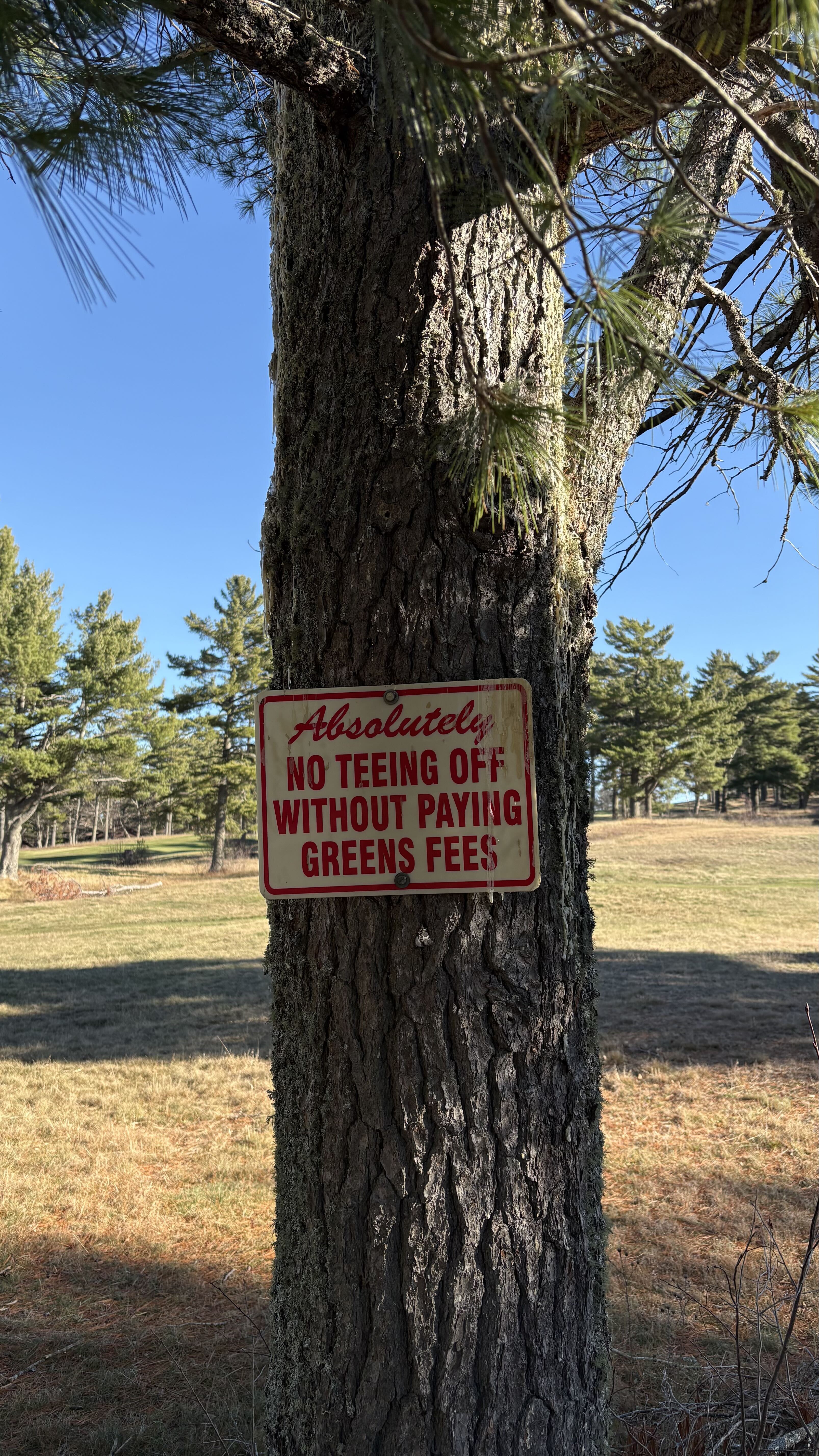
The golf course shows the pattern most clearly. Under the old membership system, “members” played for little or nothing, and some brought friends onto the course without paying. Playing without paying was common enough that the county nailed a sign to a pine on Hole 2, beside US 41, and it still hangs there: “Absolutely no teeing off without paying greens fees.” We saw it ourselves in 2019, our first season as owners.
Weekly member leagues locked everyone else off the course while they played. Members kept their own golf carts in the Lodge’s cart barn, which made it easy to bring friends out without paying a green fee.
The 2015 golf schedule shows how much of the course went to local players instead of cabin guests (Lodge records). There were 11 tournaments over 13 days, all but one with a shotgun start, which puts a group on every hole at once so no one else can play. They included Memorial Day, Labor Day, two Saturdays in June, and two full weekends. On top of that, a men’s league took the course every Wednesday evening and a women’s league every Tuesday morning, all summer. League play cost a member $35 for the entire season. A guest who booked a cabin to play golf could arrive on a holiday or a summer weekend and find the course closed to them.
The word “member” was misleading. A Lodge golf membership was really a season pass: one payment for unlimited golf all summer, plus discounts on carts and in the pro shop (KML, 2019). The county sold 66 of them in 2014 and 48 in 2015. Most went to people who lived nearby: 48 of the 66 in 2014 lived in Keweenaw or Houghton County, and more than half kept their own carts in the Lodge’s cart barn.
Memberships began as a way to fill the course. In 1955, the Lodge started selling golf tickets of eight rounds for $10, which grew into annual memberships (LaVanway, page 40). Fifteen years before that, the Lodge’s 1940 rate card offered golf at no charge to guests in the cottages and a nominal charge to everyone else (LaVanway, page 36). Today’s one free round a day for cabin guests goes back to how the Lodge began.
The passes were cheap. In 2018, the county’s last season, a single pass cost $375 and a couple or family pass $475, for unlimited golf from mid-May to mid-October. Keeping your own cart in the Lodge’s barn cost $125 more for the whole season (Lodge records). A member who played twice a week all season paid about $9 a round, less than any guest paid for a single round. When the Lodge set cart storage at $300 in 2020 to match other area courses, it was more than double the old rate (KML, 2019). All 37 passes and cart fees together brought in $14,625 for the 2018 season.
A season pass bought cheap golf. It did not buy a share of the Lodge, but many holders acted as if it had.
Some of those members treated the course and the bar as their own social club. That same season, a member became angry with one of our bartenders because she was serving cabin guests. He demanded that she stop and serve him first, before she had finished with the guests in front of her.
The members did not only lobby the people who ran the Lodge. At times they were the people who ran it. At least one person serving on the Lodge’s governing board was also a golf member. The people deciding how the course was priced and run included people who played it for little or nothing. That board was the one running the Lodge: first the Keweenaw County Park Trustees, and later the county’s Keweenaw Mountain Lodge board.
That is what the county years taught: a small group of regulars believed the Lodge existed for them first, and paying guests came second. The numbers told the same story. In 2019, golf operated at a loss, and membership dues were only about 2% of golf revenue (KML blog, Oct 2019). Starting in 2020, we ended memberships and tournaments, and cart storage ended after the 2020 season, so that anyone could play the course at any time. Rounds went up about 17%, from 2,900 in 2019 to 3,404 in 2020 (2020 recap; 2021 recap). Opening the course to everyone brought more golfers, not fewer.
When we announced the change in 2019, the pushback came in the comments on our own blog. Long-time members argued they had supported the course longer than we had known of it. Others called the change anti-local, asked us to bring memberships back, or said residents deserved special treatment. One member complained that a league tee time had kept his group off the course. The common thread: the course had belonged to them, and a new owner had no right to change that. Those comments are still public on our website (Sep 2019 post; Oct 2019 post).
The clearest example on the record came in November 2007. The county board voted 3–2 to hand the Lodge to independent professional management, as a study had recommended two years earlier. The decision met considerable opposition from the county’s own Parks and Recreation Commission, which oversaw the Lodge, and from some local business owners (Keweenaw Now, Dec 2007). One speaker at the board meeting, a former Lodge employee with 25 years in hospitality, put it plainly: “It’s not being managed.” The county commissioner who led the opposition on the board, and two members of the parks commission, were golf members at the Lodge. The people deciding whether outsiders should run the Lodge included the people who played its course for next to nothing. The board had voted for it, but a management firm was never hired. Nine years later, the county’s 2016 study found that professional management still had never happened, and the county ran the Lodge itself until the day it was sold.
What the Decline Looked Like
By 2016, the Lodge had lost money three years in a row and had not made a bond payment since December 2013. The county’s own consultant found that the Lodge was not struggling for lack of demand or because of competition. It was struggling because of how it was run.
The Lodge’s own books tell the same story back to 2008. Once bond interest is counted, it lost money every year: $30,196 in 2008, $274,637 in 2009, $296,108 in 2010, $237,279 in 2011, $300,955 in 2012, and $234,101 in 2013, and the 2008–2010 figures do not even include depreciation. In 2008 and 2009, the Lodge’s checking account sat below zero for months at a time, falling to about $198,000 overdrawn in June 2009. By mid-2010, it owed the county’s other funds more than $550,000, and in 2011 the county put $617,853 from its general fund into the Lodge to cover it. The books also flattered the results: for 2015, the Lodge’s own statement showed a $52,982 profit because it left out depreciation and bond interest, while the county’s audit of the same year showed a $176,184 loss (Lodge profit-and-loss statements and balance sheets, 2008–2015).
The county’s own audits show what that looked like. From 2014 through 2017, the Lodge lost $226,626, $176,184, $368,767, and $207,771. Even before depreciation and interest, it barely broke even: its operations brought in about $3,000 in cash in 2014, $60,000 in 2015, and $5,000 in 2017, and lost $147,000 in 2016. That was nowhere near the $73,873 a year it owed in bond interest. The interest went unpaid and grew to $492,200 by the end of 2017. The last regular bond payment, in 2010, was made by the county, not from the Lodge’s own revenue. In 2016, the county put $126,962 from its general fund into the Lodge’s operations, and in 2018 it was still lending the Lodge money weeks before the auction (Keweenaw County audited financial statements, 2014–2017; county board minutes, July 18, 2018).
The expansion that created that debt was built on hopeful numbers. The county’s 2005 feasibility study projected 60% occupancy at $100 a night in the first year and total revenue of $2.3 million by 2010, enough to pay the USDA loan with cash to spare. Its own data showed lodging in Keweenaw and Houghton Counties averaging 30% to 39% occupancy from 2001 to 2004. Its budget set aside nothing for replacing worn-out buildings, and it assumed a professional hotel management company that the county never hired. In 2011, the Lodge’s revenue was $982,875, less than half of the projection (2005 feasibility study, pages B-4, E-11, and H-2; Lodge financial summary).
The last full year under the county showed what happened when the Lodge did less. In 2017, unsure whether the Lodge would stay open, the county cut back restaurant service, hours, and staff. Through October, restaurant income fell 13%, banquets 39%, the bar 22%, and golf 21%, while lodging income rose 4%. With fewer businesses to run, the Lodge’s operating result before depreciation and interest improved by about $189,000 over the same months of 2016, from a loss of $120,202 to a gain of $68,812. Some of that came from also cutting maintenance and marketing, which only pushes costs into the future, but most of it came from running fewer businesses (Lodge profit-and-loss comparison, January–October 2017).
Visitors saw it too. One longtime guest, writing in 2021, said they had watched food and service deteriorate over the years and called the Lodge before the sale “a business in decline” (Tripadvisor).
| When | What happened | Source |
|---|---|---|
| 1988 | Winterization study finds the buildings need new foundations, insulation, and heat, and the Lodge a new roof; says rates are too low; recommends a capital improvement program and a separate authority to run the Lodge. Winterization shelved | 1988 winterization study |
| 2005 | Feasibility study for the expansion finds a “dated” Lodge, records guest complaints about service and cleanliness, and recommends a professional hotel management company and standard hotel accounting; not acted on (2005 study) | Best Use Study |
| 2006–2007 | $3.86 million expansion and winterization, including a conference center; funded by federal grants and three USDA revenue bonds of about $1.79 million | Best Use Study |
| Dec 2007 | First planned winter opening canceled because of water, sewer, and winterization problems; operating losses in the first year of the expansion; county lends the Lodge $90,000 | Keweenaw Now |
| 2008–2013 | Losses every year after bond interest; checking account overdrawn for months in 2008 and 2009; Lodge owes the county’s other funds more than $550,000 by mid-2010; county general fund puts in $617,853 in 2011 | Lodge financial statements |
| 2009–2011 | Open two winter seasons, as a condition of the grant | KML timeline |
| 2010 | Last regular bond payment, made by the county rather than from Lodge revenue | County audit, 2014 |
| Aug 2011 | Board recommends ending winter operations after heavy winter losses | Minutes |
| Dec 2013 | Last bond payment made | Mining Gazette |
| 2013–2015 | Net losses of $226,101, $225,137, and $147,172; labor at 45–51% of income, against about one-third for the industry | Best Use Study |
| 2014–2017 | Audited net losses of $226,626, $176,184, $368,767, and $207,771; unpaid bond interest grows to $492,200 | County audits, 2014–2017 |
| 2016 | County general fund puts $126,962 into Lodge operations; restaurant service cut; high staff turnover | County audit, 2016 |
| Nov 2016 | Board votes 4–1 to lend the Lodge money to open for 2017 | Minutes |
| Sep 2017 | $1.5 million offer from a hotel company, later withdrawn | CBS Detroit |
| Dec 2017 | Lodge fund shows a $439,491 deficit | Minutes |
| Apr 2018 | Board votes unanimously to auction the Lodge to resolve its bond debt | Minutes |
| Jul 26, 2018 | Public auction at the Lodge | Mining Gazette |
| Sep 5, 2018 | Sale closes; the county is released from its debt | Mining Gazette |
By 2004, the Lodge’s own guests were saying it. For the county’s 2005 feasibility study, consultants surveyed the Lodge’s 2004 summer guests. One wrote that “quality of service & cleanliness have declined.” Others described shabby rooms, a cabin with no heat on a honeymoon night, televisions that did not work, and a 45-minute wait for breakfast, and several said they would not come back. The study found that the Lodge’s staff, its management, and county officials all knew the Lodge looked “dated” and fell short of modern guest-room standards (2005 feasibility study, pages B-6 and E-38 to E-40).
The warning signs were on paper even earlier. A 1988 study for the county reported that the Lodge cleared about $102,900 a year. That figure counted only the labor and operating costs of the restaurant, bar, cabins, and golf course. It left out building operation and maintenance, administration, and depreciation, which the same study’s projections put at more than $300,000 a year, and the Lodge’s books already carried $1.5 million in depreciation that had never been charged against income. The study found the Lodge’s rates were below those of competitors and private operators, called for a long-term capital improvement program, and suggested a separate authority to run the Lodge so the whole county would not carry its risks. It even advised the county to judge the Lodge by what was best for the county “and not as a private sector business would” (1988 winterization study, pages 82–85 and 101–103). The county shelved the plan, and the numbers kept looking better than the buildings.
A Revolving Door at the Top
From 2015 to 2018, the person running the Lodge changed at least four times. In January 2015, the general manager turned down the board’s offer of $36,000 a year and gave 30 days’ notice (minutes). In September 2015, the board let the director of operations go and never said why (Mining Gazette). A new general manager started in April 2016. By 2017, another had taken over and ran the Lodge through the sale (KML press release).
No business can follow a plan when its leader changes every year. A manager who tried to make real changes answered to a board that answered to the same small group of customers.
The longer record makes the pattern plain. In its first 55 years, the Lodge had 9 managers, and two of them ran it for 42 of those years. From 1990 to the 2018 sale, it went through at least nine people in charge, and three times the bookkeeper had to step in as acting manager. A retired county road commission engineer, looking back in a 2010 history of the Lodge, described the manager’s job as “an intensely political position” because the Lodge was county-owned. (Paul LaVanway, The Keweenaw Mountain Lodge Story, 2010, page 45.)
Since 2018, the same owner has been in charge, and apart from about a year in 2021 and 2022, when an operations lead handled day-to-day work, he has run the Lodge himself (Managers of the Lodge). From 2019 through mid-November 2026, our family logged more than 63,000 hours of work at the Lodge in its own timekeeping records. John, the owner, has taken no pay since the purchase and logged about 24,800 of those hours, about 4,000 a year since 2023. Today the family works about two-thirds of all the hours at the Lodge, up from about one-tenth in 2019.
Five Layers of Shingles
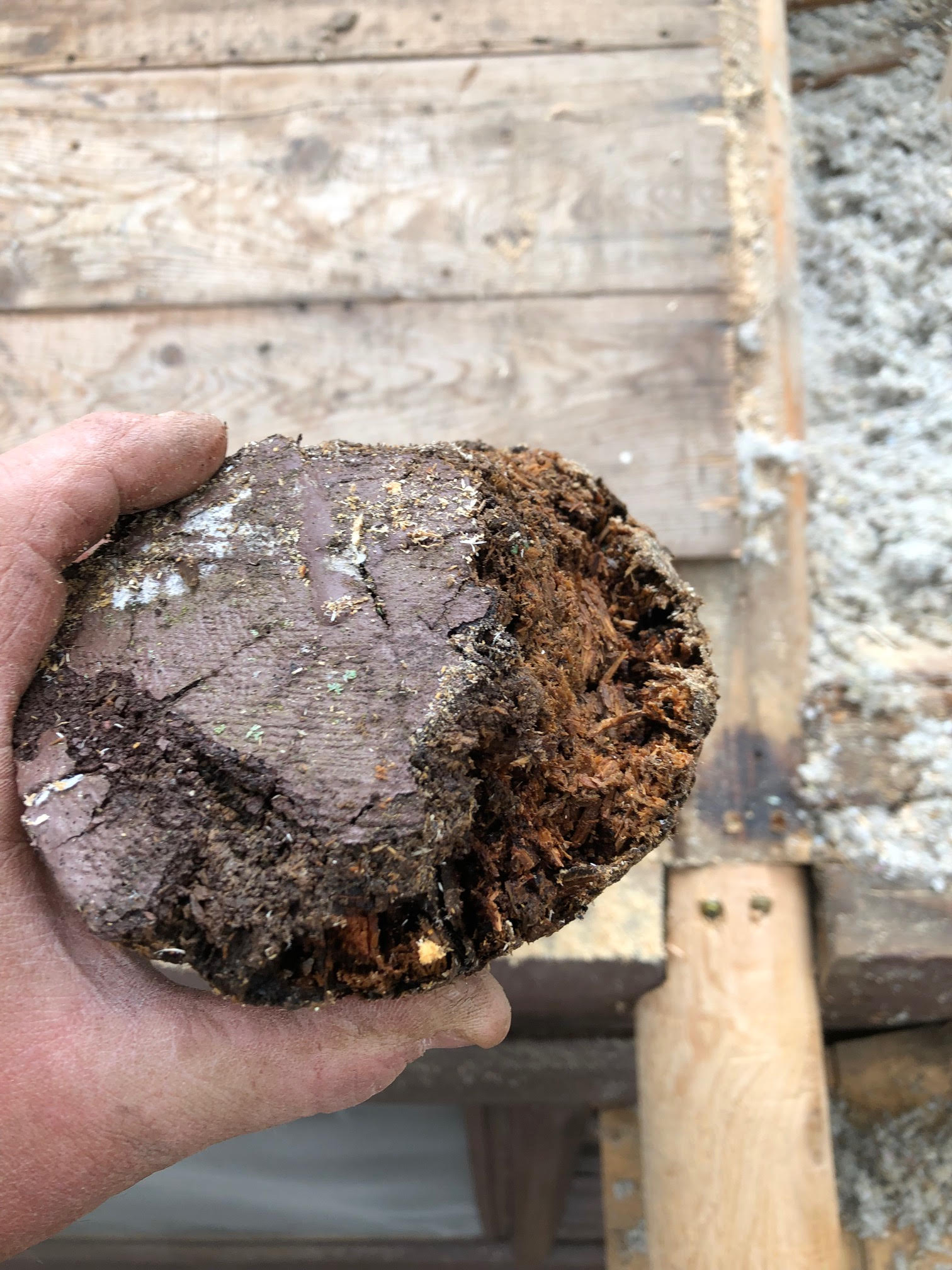
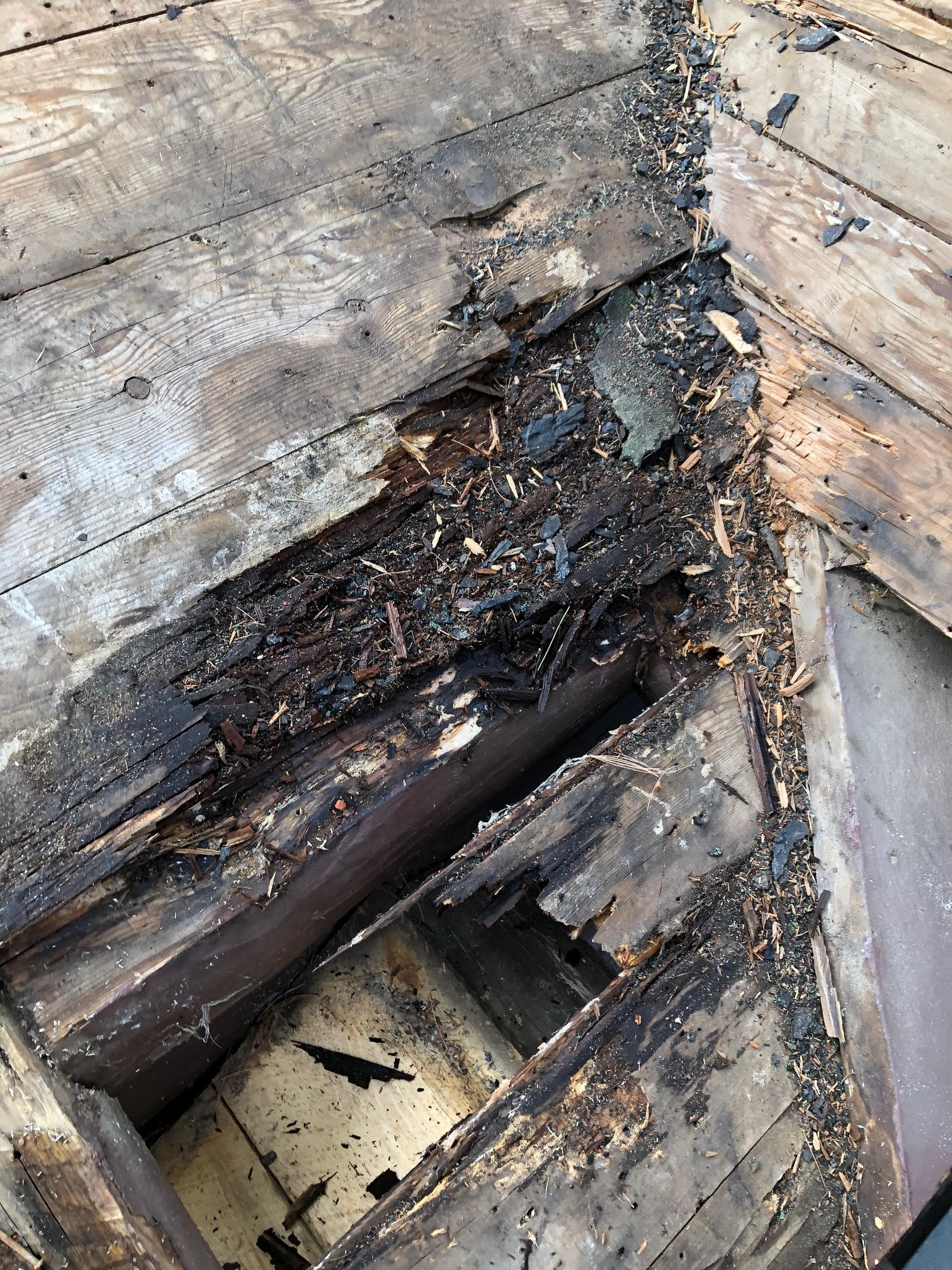
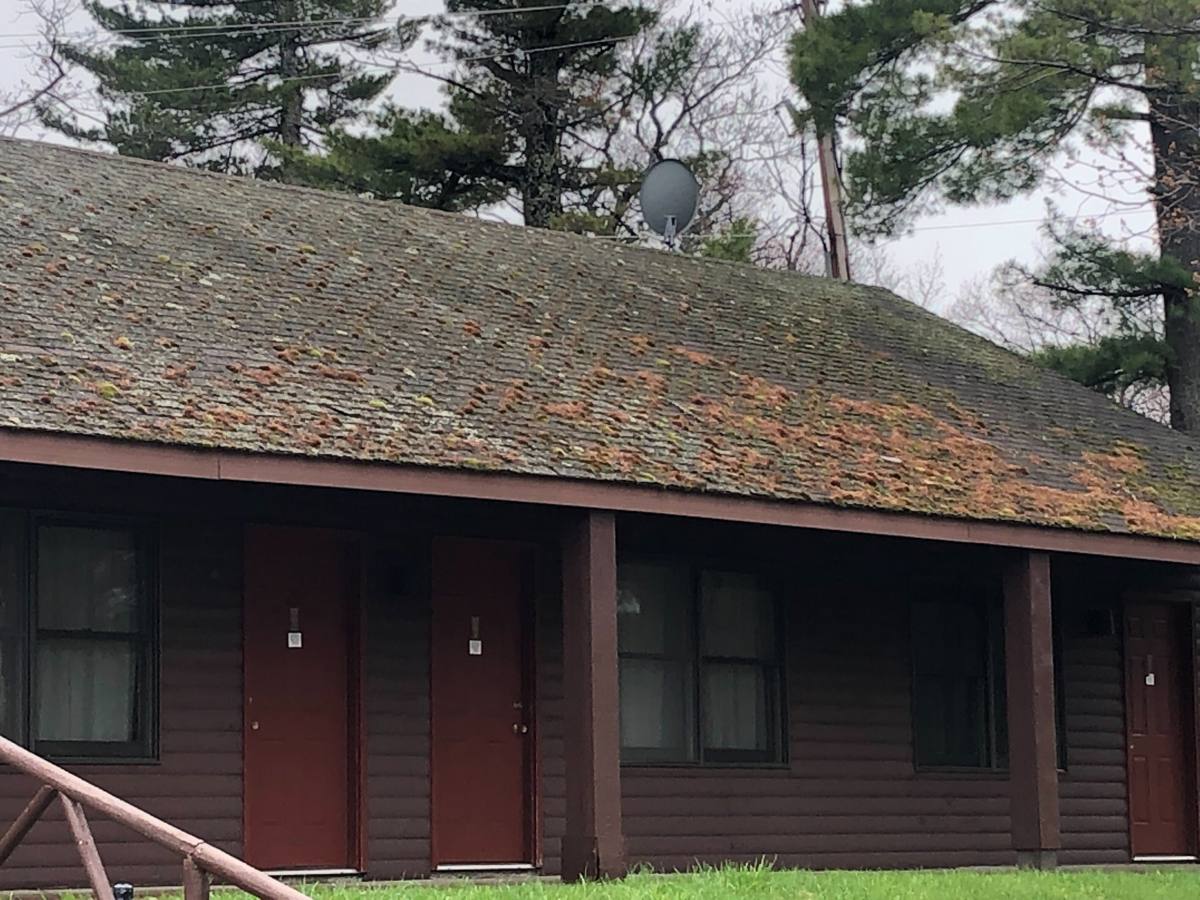
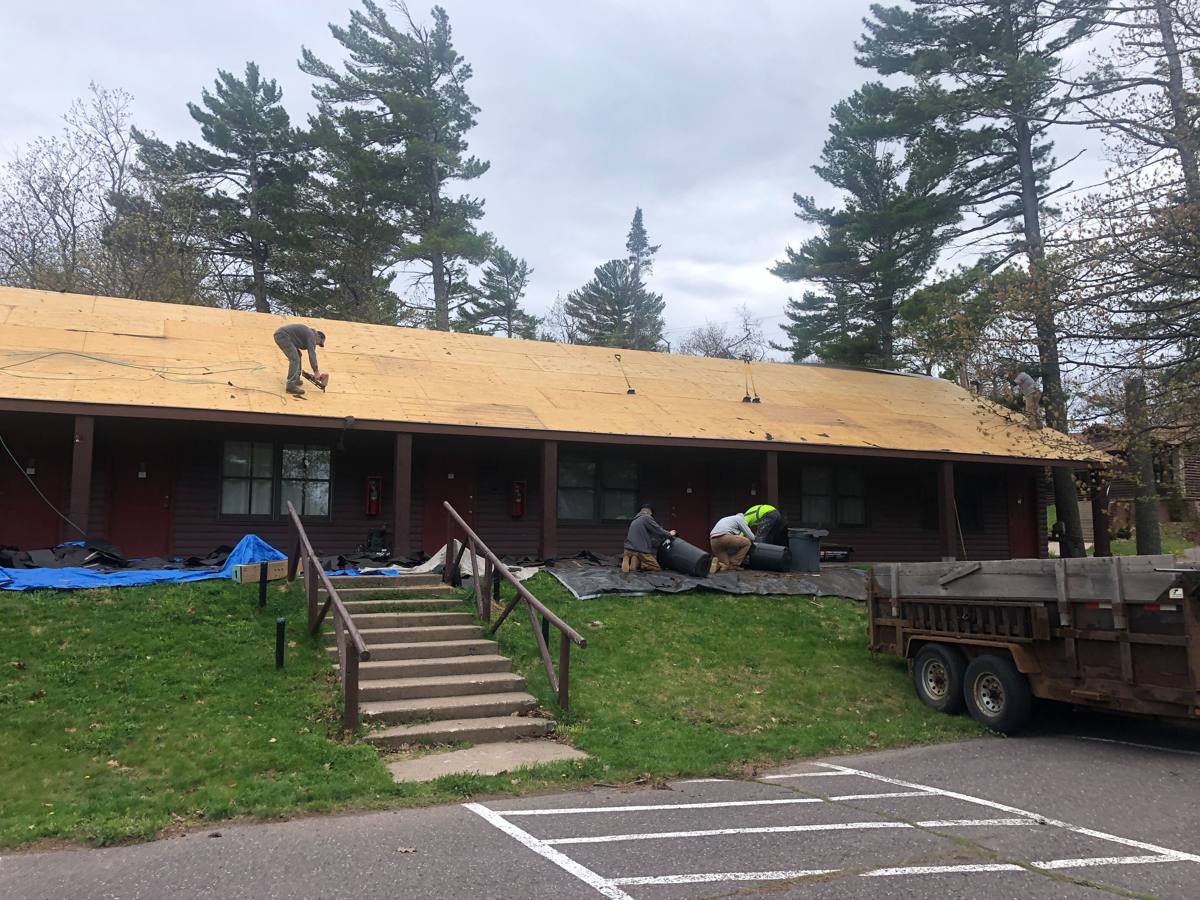
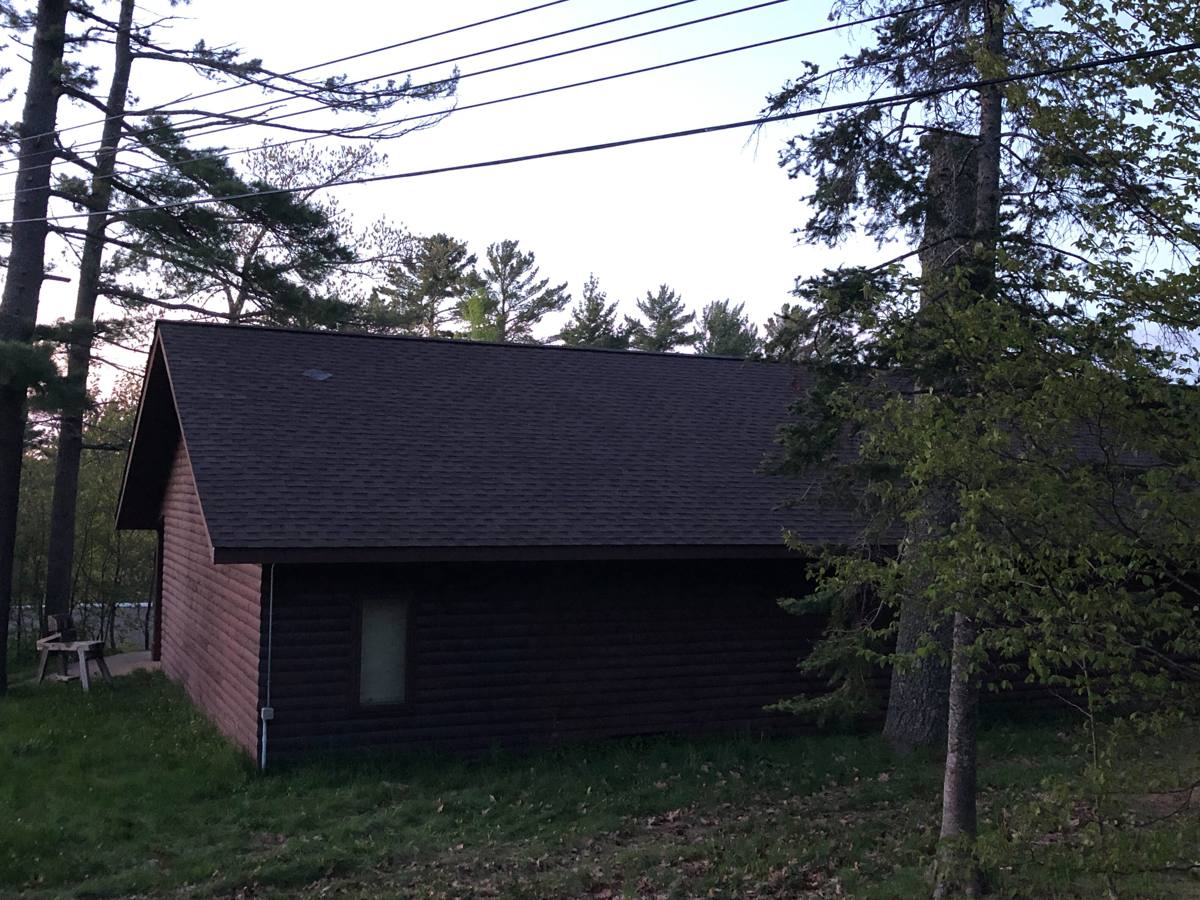
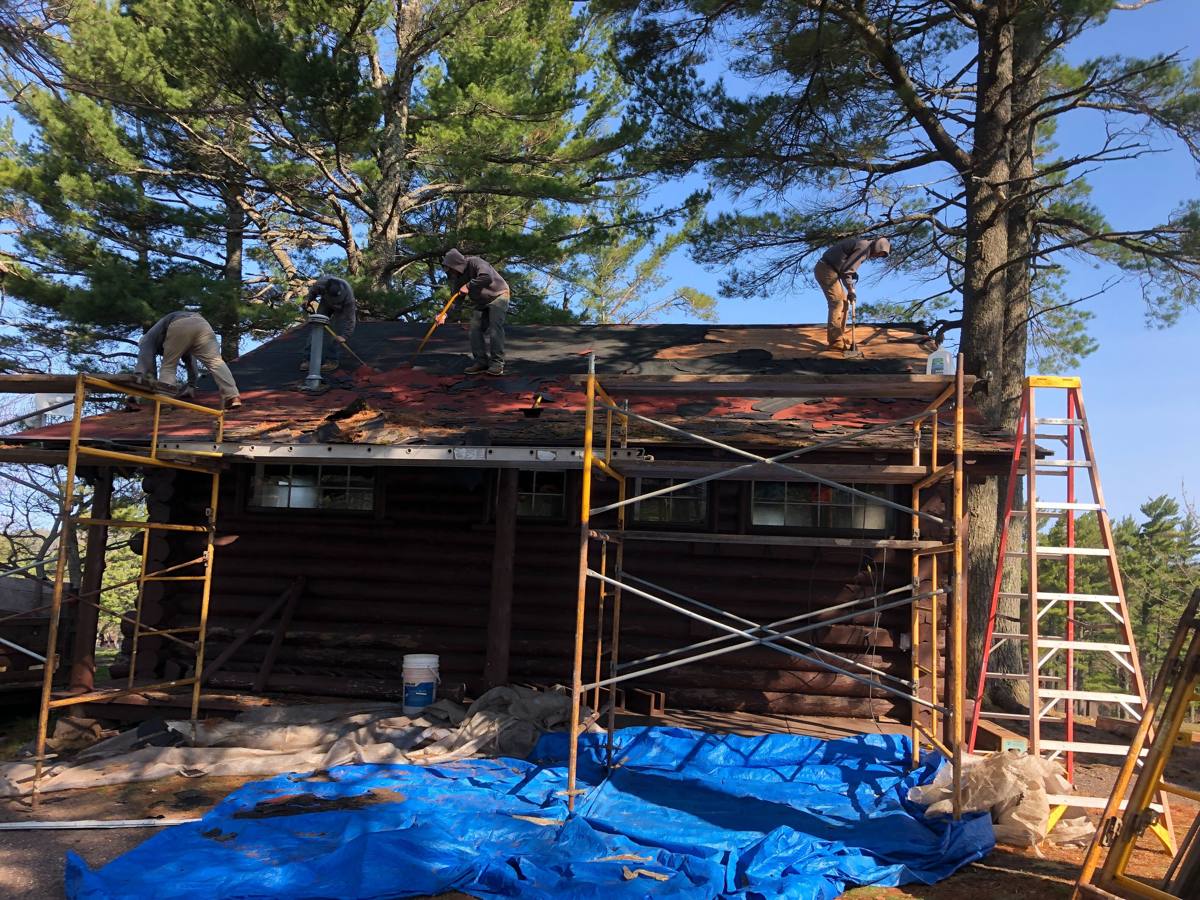
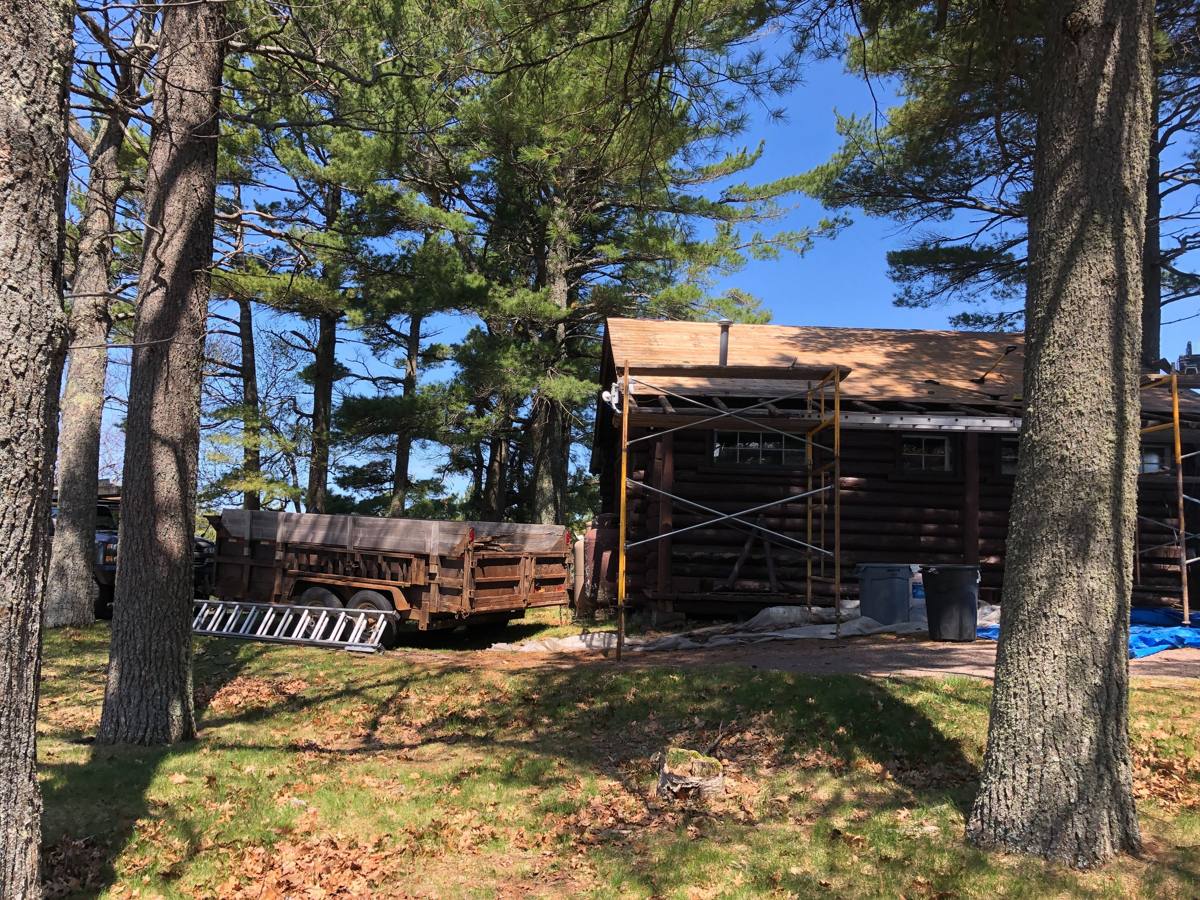
The clearest sign of what those years cost is on the roofs. When we reroofed the golf-course-side cabins in spring 2019 and the forest-side cabins in spring 2020, we found up to five layers of shingles. The roofs had not been replaced in more than 30 years, and they were falling apart. Each time a roof failed, a new layer went on top of the old one. Ours was the first full tear-off since the cabins were built between 1936 and 1940.
When we announced the finished project in May 2020, we described what we had found: shingles deteriorating, cabins leaking, and moss growing on the roofs (KML, May 2020). In the Keweenaw, a failed roof does not stay a roof problem. Snow load and water rot the logs underneath. Our photos from the tear-off show exactly that: roof boards rotted through around the valleys, porch rafters split and rotted through, and wood ends rotted soft.


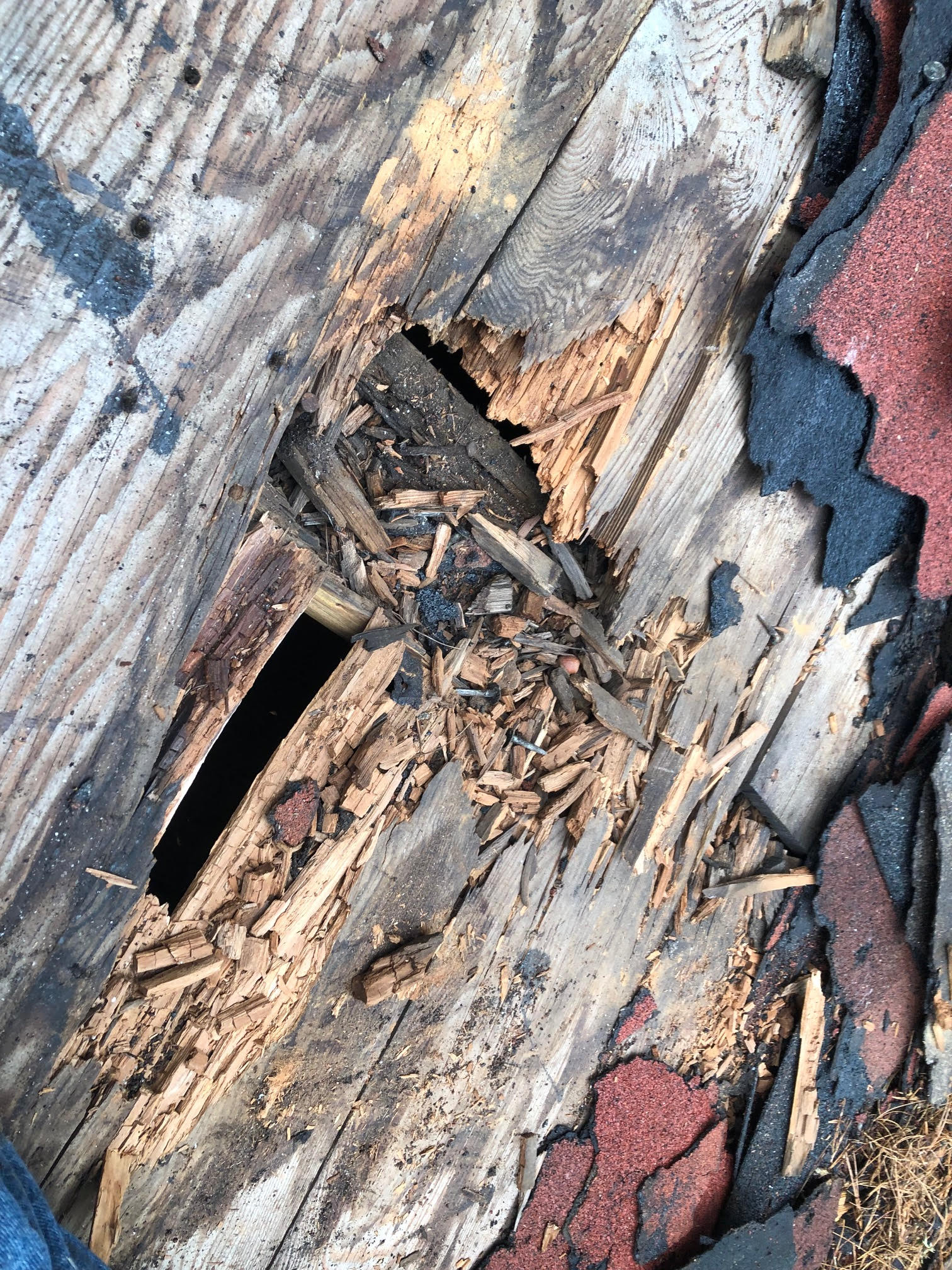
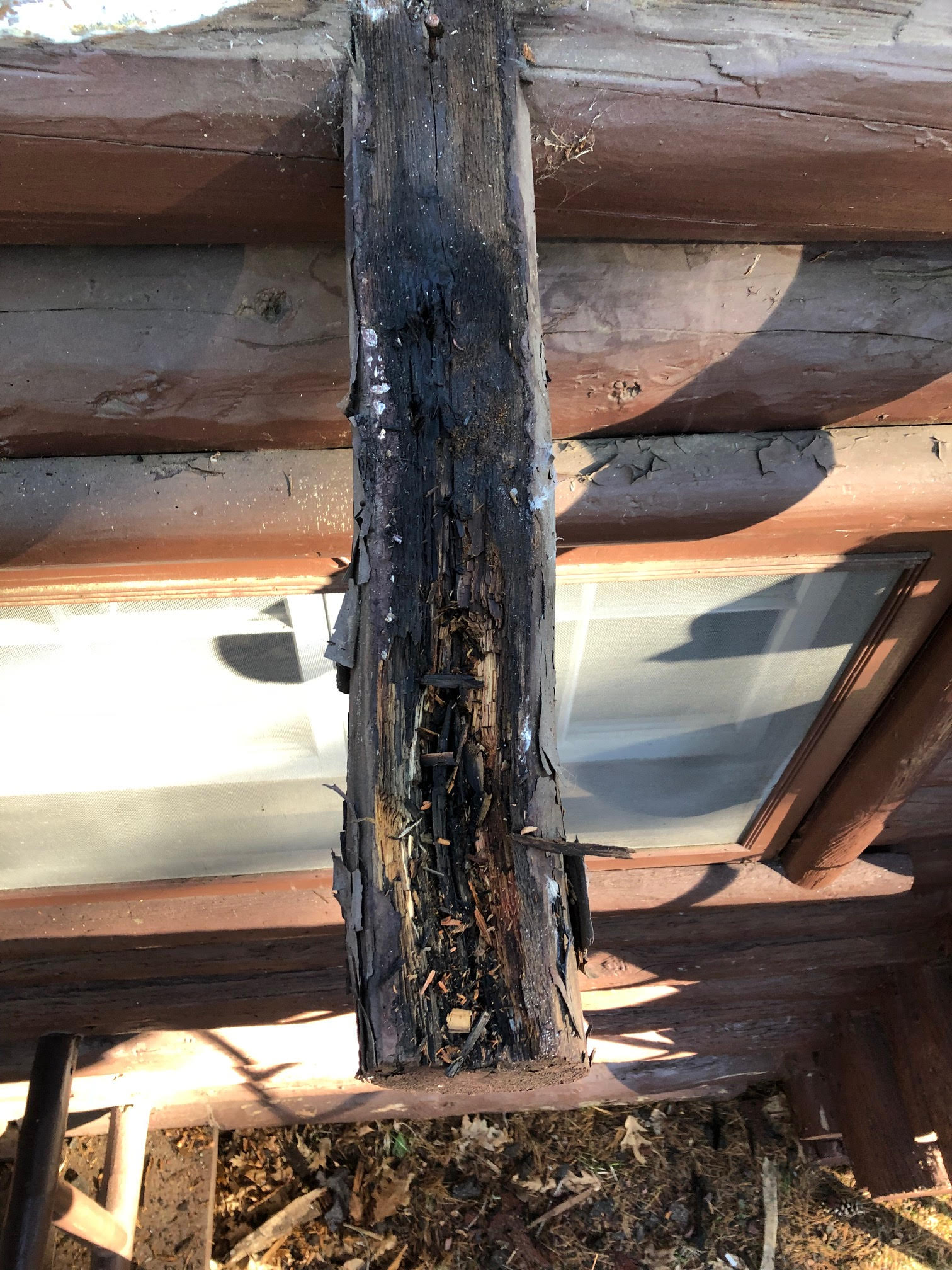
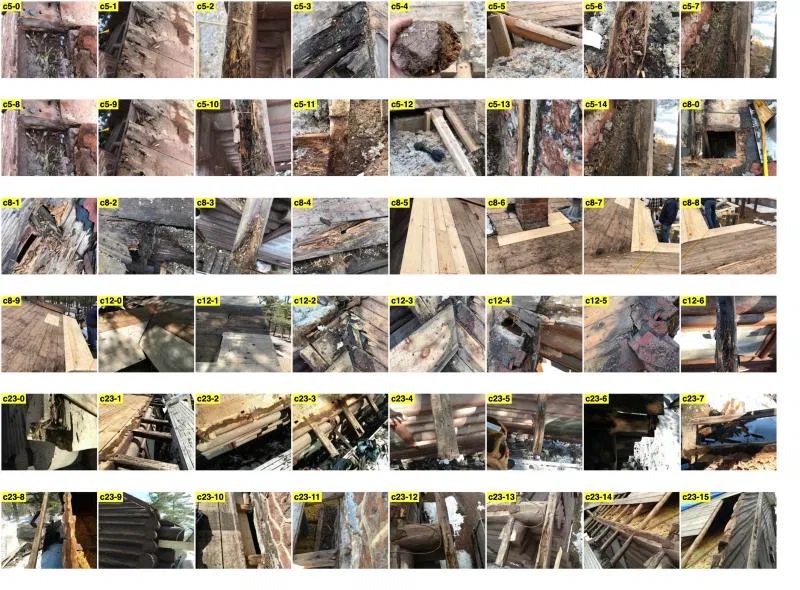
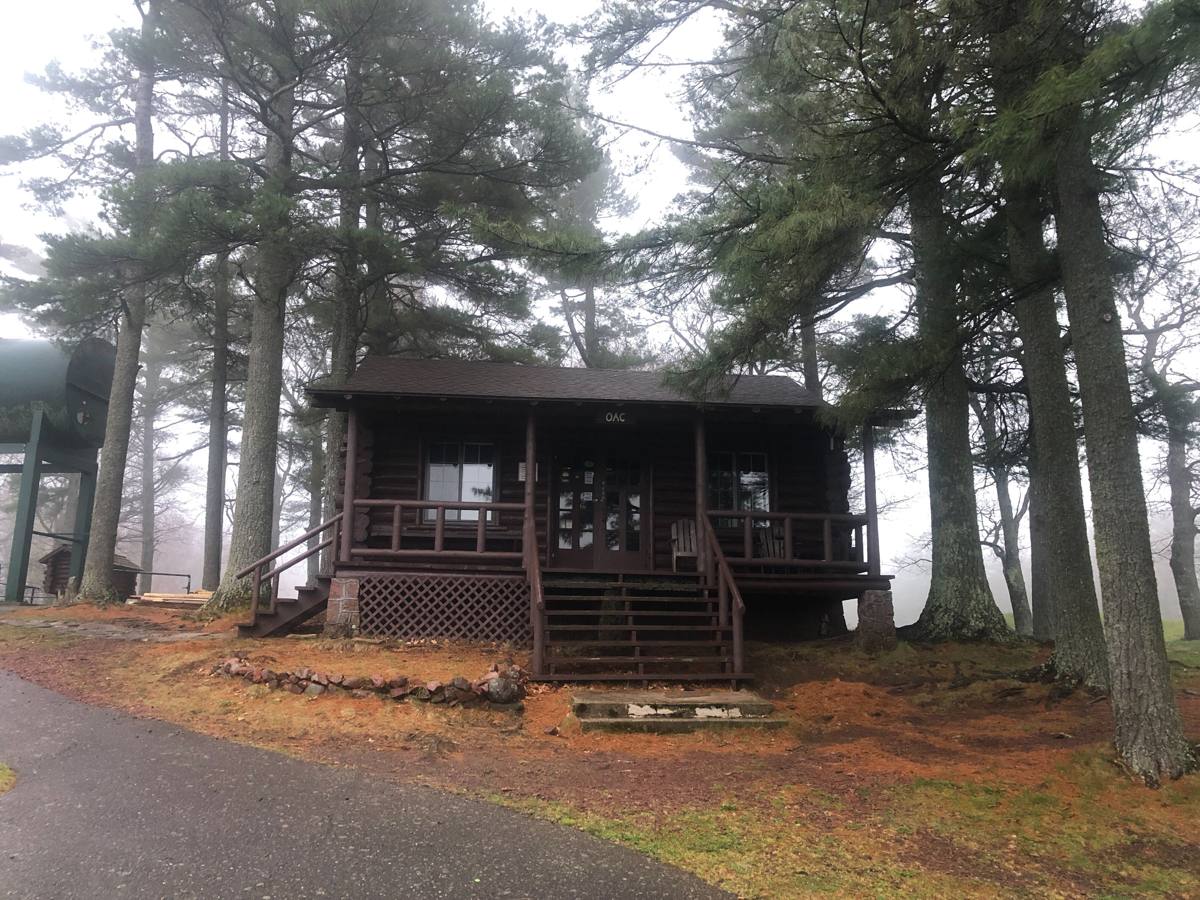
The roofs did not stop with the cabins. In 2024 we reroofed the Outdoor Activity Center and the employee housing building, which was once the hotel, and replaced the housing building’s roof decking. Counting the cabins, we have spent about $250,000 on roofs alone since 2019.
The bathrooms told the same story. When our crew opened up the bathrooms in one forest-side cabin in December 2021, they found rotted wood around the toilet (Lodge records).
Layering shingles is the cheapest fix there is. It keeps the rain out for a few more years and pushes the real cost to whoever comes next. That is how a property is managed when no one at the table expects to pay for its future. The habit was old. A retired Road Commission clerk told the Lodge’s historian that the Lodge was always run on a cash basis, with no depreciation and no capital fund for long-term repairs, so its reported profits looked better than they were. In the early 1960s, the manager was already warning the Park Trustees that the roofs needed replacing (LaVanway, page 41).
The Sale, and What Did Not Change With It
Anyone Could Have Bought It
The Lodge did not change hands quietly, and it did not go to an insider. It was offered to everyone, twice, over 16 months.
First, on the open market. In March 2017, under orders from the federal agency that held its debt, the county listed the Lodge for sale through a commercial real estate broker at $1.5 million, its appraised value (WGRD). The listing was public. The county’s money troubles had been in the local news for years, and the board said openly that it could no longer subsidize the property. Four potential buyers toured it (WNMU). A hotel company signed a letter of intent at the full asking price, then walked away in November 2017 (CBS Detroit). A second buyer backed out too.
For more than a year, the door was open to anyone: a local group, a family with roots in the county, the regulars who treated the Lodge as their own, or the golf members who played it for next to nothing. None of them made an offer.
Second, at a public auction. In April 2018, the county voted to auction the Lodge to pay off its federal debt (minutes). The auction was advertised, open to anyone who registered to bid, and held at the Lodge itself on July 26, 2018. Anyone who believed the Lodge belonged to them could have registered and raised a hand. We did. We were the second-highest bidder. The sale price was $1,292,500, less than the $1.5 million asking price a year earlier (WLUC). Within a week, the high bidder decided he had overpaid and looked for another bidder to take over his position. On August 1, 2018, we did (WLUC). The county paid the auction company’s fee out of that price, and all of the rest went to its two federal creditors, still less than the roughly $1.6 million it owed them.
The people who now say the Lodge was taken from them had two chances to own it. They passed both times. The current owners did not.
When the sale closed on September 5, 2018, it released the county from more than $4 million in federal obligations built up under county ownership (Mining Gazette). Since then, the cost of keeping a 90-year-old property standing has been carried by its owners, not by taxpayers, and not by the people who still call us “new owners.”
The sale also settled what the public is actually owed. The deed carries a historic preservation easement that protects the Lodge building, the former conference center (now our Education Center and the Little Cabin Cafe), the golf course, and the 1930s cabins, and that requires public access on at least 12 days each year. It also requires the owner to restore, maintain, and preserve those buildings to federal historic standards, at the owner’s own cost, forever (2018 warranty deed and historic preservation easement). The easement asks for public access on 12 days a year. We go well beyond it. The Keweenaw Mountain Lodge is a lodging establishment, and anyone can rent a cabin and use the property any day we are open. The Keweenaw Dark Sky Park on our grounds is open to the public every night from 7 p.m. to 7 a.m. whenever the Lodge is open, which is all year except from mid-November to mid-December and in April.
The sale also reversed the flow of money. For years, the county kept the Lodge open with money from its general fund. Before 2011, it had already moved $221,475 into the Lodge and loaned another $216,378 to open the 2011 season (minutes). In November 2016, after a commissioner noted the county had already put in more than $700,000, the board approved $152,000 more to get through the winter and open in 2017 (minutes; WLUC). General fund transfers continued into 2018, from $9,000 to $50,000 at a time (Jun 2017; Feb 2018). Under county ownership, the Lodge also paid no property taxes at all (2018 auction brochure). From 2018 through 2026, we will have paid more than $280,000 in property taxes. That money supports the same county, schools, and townships that once subsidized the Lodge.
The Expectations That Stayed
The ownership changed in 2018. The expectations did not. Customers who had been, in effect, owners of the Lodge still felt like owners. They expected the same say, the same prices, and the same party atmosphere, without carrying any of the cost or risk.
Eight years later, we still hear it. Some reviews call us the “new owners.” Many of them come from people who are not guests at all: they tried to visit, learned the Lodge is open only to cabin guests, and went online instead. The reason given is often family history: a grandfather or great-grandfather helped build the Lodge, so it is still theirs to use. Some still hunt the land next to the cabins. Those 383 acres have been private Lodge property since 2022, and they have been posted No Hunting since then. The land is protected by a conservation easement, and under that easement hunting, trapping, and firearms have not been allowed there since 2022. The same easement keeps the land open to the public for hiking, biking, and berry picking. In 2026 we added many more signs. People hunted there anyway, every season from 2022 to 2025. Hunting a few hundred feet from occupied cabins is not a tradition. It is a danger to our guests.
This happened again just this week. A visitor walked into the Lodge building, which is open only to cabin guests, and asked to hunt our land. His reason was that his grandfather had helped build the Lodge, so he was entitled to hunt it. When the answer was no, he went online and wrote that the “new owners” have ruined the place. That was eight years after the sale, on land that has been posted No Hunting since 2022.
Nothing was taken away from hunters. The Nature Conservancy has kept most of the 32,000-acre Keweenaw Heartlands around us in Michigan’s Commercial Forest Program, which by law keeps enrolled land open to the public on foot for hunting, trapping, and fishing (Michigan DNR). And on November 5, 2026, the state bought nearly 10,000 acres of the Heartlands from The Nature Conservancy as the new Keweenaw Point State Lands, now public land with hunting approved as an allowed use (Michigan DNR). Thousands of acres around the Lodge remain open to hunting. The Lodge’s land, where guests sleep in cabins and walk the trails, is simply not one of them.
We honor the people who built the Lodge in the 1930s. Their work is why it is still standing, and it is why we care for it the way we do. But building the Lodge as a public works job did not make it a family inheritance. Respecting what they built means taking care of it, not claiming it.
This is the root of the entitlement the Lodge still sees today. It is not a judgment of any one person. It is the predictable result of a property where using it and controlling it were the same thing for decades.
What the Holdovers Leave Out
Read the negative reviews of the Lodge online, and a pattern shows up in the first line. Many open with how long the writer has been coming: for decades, for 25 or 35 years, since childhood (Tripadvisor). Many still call us the “new owners,” years after the sale. Their complaint is almost always about losing something they once had: cheap golf, a bar full of locals, access for people who are not staying here.
What they almost never mention is anything on the list above: the roofs, the year-round operation, the protected land, the certifications. They are not describing the Lodge as it is. They are describing the Lodge they once controlled.
The reviews are also the old method in a new place. When the county owned the Lodge, a customer who did not like a decision did not take it up with the manager. They took it to the board, and the board reversed the change or stopped it before it started. That is how the Lodge was run for decades. A one-star review is the same move: pressure from outside the business, aimed at forcing a decision to change. The difference now is that there is no board to carry it. The decisions are made by the people who own the Lodge, pay its taxes, and answer for its future, and they are made for the guests who actually stay here.
Some reviews complain that the grass is not cut. That complaint gives the reviewer away: it comes from someone who saw the Lodge from the highway or from Golf Course Road, not from a cabin. We leave the land along the road natural on purpose. From the road, the golf course looks like wilderness, and that is what it is meant to look like. Cabin guests see the other side: groomed ground where they walk to their cabins, and greens kept the way a 1930s course was kept. Our wilderness golf course page shows the same green twice, once as the golfer sees it and once as a driver sees it from the road. We are not trying to get people to pull in off the highway. Our guests book ahead, and they see the Lodge from the inside.
Reviews like these say more about the reviewer than about the Lodge. They are written by people who never stayed, and who want the Lodge to look like a manicured social club in the middle of a city. The Keweenaw Mountain Lodge is a place in the wilderness, meant to bring people closer to nature. We marry history with the future, and that leads to a vibrant and progressive present. The people asking for the old Lodge back are asking for the past, and it was customers holding on to that past who took the Lodge down before. We do not build the Lodge around them. We build it for the guests who come here for what it is now.
Where the Entitlement Comes From
The sense that the Lodge still belongs to some of its past customers did not start with the sale. It was built over 80 years of public ownership, and the county era taught it.
It starts with a fair feeling. The Lodge was built by the county’s own people during the Depression, and many families have real memories here. But a public property, run by a board that answered to local voters, turned that feeling into something more. For decades, a small group of regular customers learned that the Lodge would be run the way they wanted. If a manager changed something they did not like, a complaint to the board could reverse it. Their prices stayed low, their tee times came first, and their wishes outranked the guests who stayed the night. Every time the system gave way, it confirmed that the Lodge was theirs.
That expectation is what ran the Lodge down. Decisions were made for the people who complained hardest, not for the business, and the business could not survive it.
The expectation did not end when the deed changed hands. Eight years later, the same pattern shows up in the reviews that begin “I have been coming for years” and call us the “new owners,” in the requests to hunt land that has been posted No Hunting since 2022, in complaints about grass left natural along the road, and in people who are not staying here asking to be let in because a grandfather helped build the Lodge. The tools are new. A one-star review has replaced the call to a commissioner. The goal is the same: to make the Lodge serve the people who once controlled it.
The difference is that it no longer works. The Lodge is not run by whoever complains hardest, and it is not going back to the past on the demand of a one-star review. As we say on our About page, what separates privilege from entitlement is gratitude (Brené Brown). Anyone could have bought the Lodge in 2017 and 2018, on the open market or at the auction. Those who did not, and who still enjoy their memories of it, have every reason to be grateful that it is still open, still standing, and stronger than it has been in decades.
There is a well-studied reason the reaction runs so strong. People judge a change against what they are used to, not against what is fair or what keeps a place alive, and a loss feels about twice as heavy as a gain of the same size (Kahneman and Tversky, 1979). For decades, the starting point at the Lodge was cheap golf, an open bar, and access without staying. Measured from there, every change we made looks like something taken away, while new roofs, protected land, and a Lodge that will still be here in fifty years barely register. The same instinct shaped the county’s choices. A board answering to voters who feel losses that sharply has every reason to raise no prices, set aside no reserves, and change nothing. That is not a flaw in any one person. It is how people are wired, and it is why the Lodge needed an owner who could look past the reference point.
Forward, Not Backward
The customers of the past showed us the problem. Some of them still push to take the Lodge back to the way it was. We will not let that happen. Our north star is getting people closer to nature, and the data, our values, and the guests who actually stay here all point the same way: forward.
The Keweenaw Mountain Lodge is now a private business. Decisions are made by owners who carry the risk, guided by one purpose: getting people closer to nature. We share the reasons for those decisions openly, and we let people decide for themselves whether the Lodge is the right fit (About the Lodge).
What Changed After the Sale
This page explains how the Lodge declined. To read what we have done since buying it in 2018, how we watched first, let the data decide, and rebuilt the Lodge around one purpose, continue to What Changed After the Sale (2018–Today).